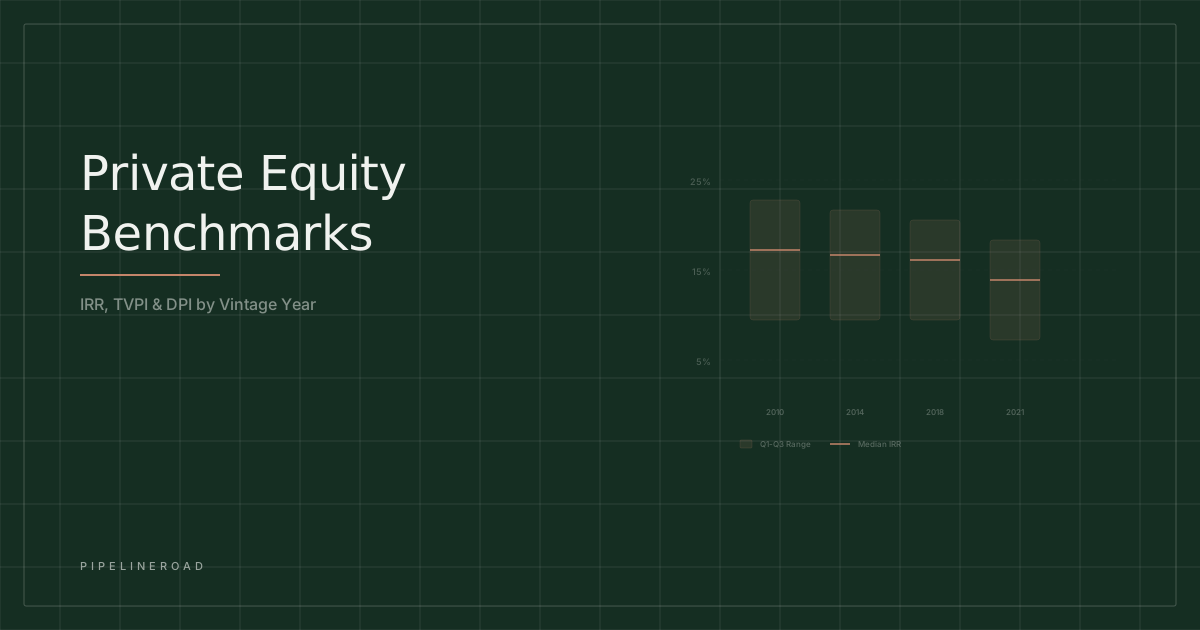
Private equity benchmarks exist to answer a deceptively simple question: is this fund’s performance good, average, or poor?
The answer requires context. A 14% net IRR means different things depending on the vintage year, strategy, fund size, and market environment. Benchmarks provide that context by aggregating performance data across hundreds or thousands of funds so that individual fund performance can be evaluated relative to peers.
This guide covers the major PE benchmark providers, key metrics, how LPs actually use benchmarks in their evaluation process, and what fund managers should know about positioning their track record.
Major Benchmark Providers
Three organizations produce the most widely referenced PE benchmarks:
Cambridge Associates publishes quarterly benchmark data covering buyout, growth equity, venture capital, real estate, infrastructure, and other private markets strategies. Their dataset spans thousands of funds globally. Cambridge uses a pooled return methodology that treats all constituent funds as a single cash flow stream, which weights larger funds more heavily. Cambridge benchmarks are the most commonly cited in LP due diligence.
Burgiss operates the Private iQ database, sourcing performance data directly from LP portfolios. Because the data comes from LPs rather than GPs, it captures a broader universe including funds that may not report to other providers. Burgiss benchmarks tend to track closely with Cambridge but can differ in specific vintage years.
Preqin maintains a database of over 80,000 private capital fund records. Preqin benchmarks are based on a mix of publicly reported data and proprietary research. They cover a broader universe than Cambridge or Burgiss but may include less rigorously verified data points.
For fund managers raising capital, knowing which benchmark provider your prospective LPs use is important. Some LPs rely exclusively on Cambridge. Others use Burgiss or blend multiple sources. Comparing your fund’s performance against the wrong benchmark, or using the wrong calculation methodology, can create confusion in LP conversations.
Key Benchmark Metrics
IRR (Internal Rate of Return)
IRR is the most commonly quoted PE performance metric and the primary benchmark comparison point. Net IRR (after fees and carry) is the standard. Cambridge Associates reports both pooled IRR (the entire benchmark treated as one fund) and horizon IRR (returns over specific time periods).
US buyout benchmark data from Cambridge Associates shows:
- 25-year pooled net IRR (ending 2023): approximately 14 to 16%
- 10-year pooled net IRR (ending 2023): approximately 15 to 18%
- 5-year pooled net IRR (ending 2023): approximately 12 to 15%
The 5-year number is lower because it includes the 2022 to 2023 period when interest rate increases compressed valuations across private markets.
TVPI (Total Value to Paid-In)
TVPI measures the total value generated per dollar of capital called, including both distributions (DPI) and remaining net asset value (RVPI). The buyout benchmark TVPI varies by vintage year:
- Vintage 2010 to 2014 funds: 1.8 to 2.2x TVPI (mostly realized)
- Vintage 2015 to 2018 funds: 1.5 to 1.8x TVPI (partially realized)
- Vintage 2019 to 2021 funds: 1.1 to 1.4x TVPI (mostly unrealized, early in lifecycle)
LPs use TVPI to gauge total value creation but discount the unrealized portion based on how confident they are in the GP’s marks.
DPI (Distributions to Paid-In)
DPI measures cash actually returned to LPs. In the current LP environment, DPI has become the most scrutinized metric. After years of paper gains from rising private market valuations, LPs want to see real cash. Use our DPI calculator to model this metric.
Benchmark DPI by vintage year (US buyout):
- Vintage 2010 to 2014 funds: 1.4 to 1.8x DPI (substantially distributed)
- Vintage 2015 to 2018 funds: 0.6 to 1.0x DPI (actively distributing)
- Vintage 2019 to 2021 funds: 0.1 to 0.3x DPI (early, mostly unrealized)
A fund that is significantly behind its vintage year DPI benchmark faces tough questions from LPs about exit execution and portfolio quality.
PME (Public Market Equivalent)
PME compares PE performance against what an LP would have earned by investing the same cash flows in a public market index. A PME above 1.0 means PE outperformed public markets. Below 1.0 means public markets would have delivered a better result.
Cambridge Associates data shows US buyout has maintained a PME above 1.0 relative to the S&P 500 across most vintage years, with the median premium approximately 200 to 400 basis points. This premium has narrowed in recent years as public equity returns strengthened, particularly in technology.
PME is increasingly important to LPs because it answers the fundamental question: is the illiquidity premium worth it? If a fund can’t beat the S&P 500 after fees and 10 years of lockup, the LP allocation case weakens significantly.
How LPs Use Benchmarks
LPs use benchmarks at two stages: initial evaluation of a new manager and ongoing monitoring of existing commitments.
Initial evaluation. When reviewing a new GP, LPs compare the GP’s prior fund performance to the relevant strategy benchmark for the same vintage year. A fund that ranks in the top quartile of its vintage year benchmark is strong. Second quartile is acceptable but not compelling. Third or fourth quartile typically disqualifies a manager from new allocations.
Ongoing monitoring. For existing commitments, LPs compare fund performance quarterly against the benchmark. A fund that starts in the first quartile but drifts to the third quartile over time raises questions about portfolio management and exit execution.
Cross-GP comparison. Sophisticated LPs don’t just compare against third-party benchmarks. They also compare GP performance across their own portfolio. If an LP has committed to 15 buyout funds in the 2018 vintage, they compare those 15 GPs against each other. Your fund’s performance relative to the other managers in the LP’s portfolio matters as much as the Cambridge benchmark.
Benchmarks by Strategy
Different strategies within private equity have different return expectations:
Buyout: The benchmark for traditional leveraged buyout funds. Median net IRR of approximately 13 to 15% over long periods. Top-quartile threshold approximately 18 to 20% net IRR.
Growth equity: Similar structure to buyout but without leverage and with minority stakes. Median net IRR of approximately 12 to 16%. Growth equity benchmarks are less established because the strategy category is relatively newer.
Secondaries: Funds that buy existing LP positions at a discount. Lower return targets (12 to 15% net IRR) but with a faster J-curve because capital is deployed into already-maturing portfolios.
Fund of funds: Diversified exposure across multiple PE managers. Returns are compressed by an additional layer of fees. Median net IRR of approximately 8 to 12%.
Positioning Your Track Record
If you are raising a fund, how you present your performance relative to benchmarks matters.
Use the right benchmark. Compare against the relevant strategy and vintage year. Don’t compare a growth equity fund against the buyout benchmark to make your numbers look better. LPs will notice, and it erodes credibility.
Show gross and net. Presenting both gross and net returns demonstrates transparency. The spread between gross and net reveals your fee drag, which LPs evaluate alongside performance.
Contextualize the vintage year. A 2008 vintage fund that returned 12% net IRR is more impressive than a 2010 vintage fund that returned 15%, because the 2008 vintage faced a much harder investment environment. Vintage year context matters.
Address DPI directly. If your DPI is below the benchmark, explain why. Legitimate reasons include portfolio companies that are growing rapidly and not yet ready for exit, or a deliberate hold strategy to maximize value. Vague answers about “unrealized upside” will not satisfy experienced LPs.
For help identifying which LPs are actively re-allocating to your strategy and vintage, our LP database covers allocation mandates and recent commitment activity across thousands of institutional investors.
Frequently Asked Questions
What is a good IRR for a private equity fund?
A good net IRR for a buyout fund is generally 15-20%, which places it in the top-quartile range according to Cambridge Associates benchmarks. Top-decile funds achieve 25%+ net IRR. The median US buyout fund has historically delivered approximately 13-15% net IRR over 10-year horizons. Context matters: a 15% IRR in a challenging vintage year (2007-2008) is more impressive than 15% in a tailwind vintage (2010-2012).
What benchmarks do LPs use to evaluate PE funds?
The most widely used PE benchmarks come from Cambridge Associates, Burgiss, and Preqin. LPs typically compare fund IRR, TVPI, and DPI against the relevant strategy benchmark (buyout, growth, venture) for the same vintage year. Many LPs also calculate Public Market Equivalent (PME) to compare PE returns against what they would have earned in public equities. Increasingly, LPs compare across GPs they've invested with rather than relying solely on third-party benchmarks.
How are private equity benchmarks calculated?
PE benchmark providers aggregate performance data from thousands of funds. Cambridge Associates uses a pooled IRR methodology that treats all constituent funds as a single portfolio, weighting larger funds more heavily. Burgiss uses a similar approach with its Private iQ database. Both are net-of-fees benchmarks. It is important to compare like-for-like: buyout funds against buyout benchmarks, growth equity against growth benchmarks, and within the same vintage year.